Where and When to See the Northern Lights in Norway?
The Northern Lights rank among the most sought-after natural phenomena by travelers. Year after year, they captivate visitors from every corner of the globe, drawn to witness this rare spectacle of the Arctic sky.
The Northern Lights rank among the most sought-after natural phenomena by travelers. Year after year, they captivate visitors from every corner of the globe, drawn to witness this rare spectacle of the Arctic sky. Norvège stands out as a privileged destination for observing them, thanks to its long winter nights and regions situated beyond the Arctic Circle. So when and where should you travel in Norvège to experience this extraordinary moment?
Understanding the Northern Lights Phenomenon
The Northern Lights emerge from the encounter between the Sun and our atmosphere. Charged particles emitted by solar wind are attracted by Earth's magnetic field and guided toward the poles. As they collide with oxygen and nitrogen atoms at high altitude, they release energy in the form of light, painting these luminous curtains across the night sky.
This phenomenon appears primarily in zones near the polar circle, where Earth's magnetic field intensifies these interactions. This is why Norvège ranks among the best places for observation.
To experience them fully, one essential condition remains: darkness. The longer and clearer the nights, and the farther from artificial light pollution, the greater your chances of witnessing this spectacle.
When to See the Northern Lights in Norway?
In Norvège, the season favoring Northern Lights extends from autumn through early spring. The long nights of the Arctic winter provide ideal conditions for observing this luminous phenomenon, though certain periods prove particularly promising.
- Ideal season: September to March, when nights are sufficiently long and dark.
- Most favorable months: November to January for maximum darkness; February and March for often clearer skies and the equinox effect.
- Key conditions: clear skies, absence of light pollution, and several consecutive nights to increase your chances of observation.
Where to See the Northern Lights in Norway?
Situated at the heart of the auroral oval, Norvège offers several remarkable regions for admiring the Northern Lights:
- Tromsø: Capital of the Arctic, this vibrant city stands as one of the most accessible and celebrated spots. Excursions, specialized accommodations, and winter activities make it an ideal base.
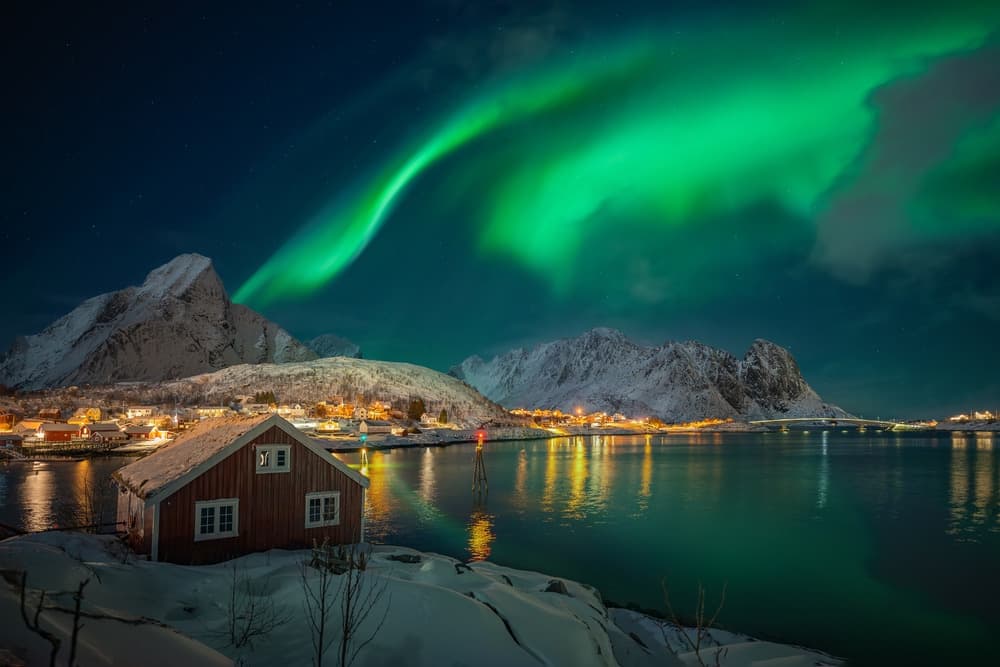
- Lofoten Islands: Spectacular landscapes between fjords and dramatic peaks, where auroras reflect upon the sea.
- Alta and North Cape: Alta earns its nickname as the "city of the Northern Lights," while North Cape offers long polar nights perfect for observation.
- Svalbard: An archipelago positioned midway between Norvège and the North Pole, it allows you to glimpse the auroras even during daylight thanks to the polar night lasting several weeks.
What Experiences Await Around the Northern Lights in Norway?
In Norvège, waiting for the Northern Lights transforms into a genuine adventure through countless activities:
- Igloo stays or ice hotel lodges: In Finnmark or near Tromsø, unique accommodations such as the Sorrisniva Igloo Hotel or the panoramic domes of Lyngen North offer the chance to admire the boreal sky from the comfort of your bed.
- Dog sledding or snowmobile safaris: Guided by a pack of huskies or propelled on a snowmobile, you explore snow-covered plateaus in search of clear skies.
- Polar cruises: Coastal cruises, notably with Hurtigruten, offer privileged observation far from light pollution, complete with lectures and evening activities on board.
- Photography observation and photo workshops: Specialized guides teach you to capture the luminous veils and return home with your own shots.
Practical Tips to Maximize Your Chances
- Plan for several nights on location: a stay of at least three to five nights increases your probability of spotting the Northern Lights.
- Use forecast applications: tools like Norway Lights or My Aurora Forecast provide reliable estimates of solar activity and cloud cover.
- Dress for extreme cold: opt for technical clothing in multiple layers (merino wool, windproof and insulating jacket, warm gloves, hat, adapted boots).
- Exercise patience and flexibility: observing the Northern Lights remains uncertain and cannot be guaranteed. Be prepared to venture out late, wait, and relocate toward areas with clearer skies.