Where and When to See the Northern Lights in Norway?
Thanks to its geographical location, Norway is an exceptional country for seeing the Northern Lights. With vast untamed landscapes, it also makes it easy to escape the light pollution of urban areas.
Thanks to its geographical location, Norway is an exceptional country for seeing the Northern Lights. Dotted with vast wild expanses, it also makes it easy to escape the light pollution of urban areas. Discover the best times to observe the Northern Lights in Norway, the must-see observation spots and our tips for a successful experience!
Why Norway is one of the best countries to observe the Northern Lights
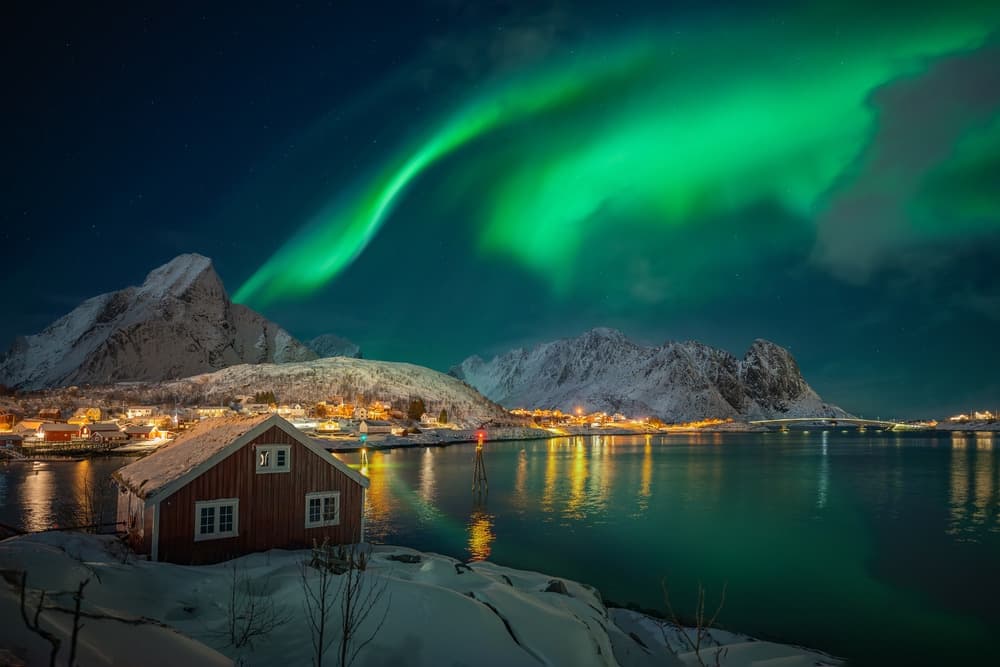
The Northern Lights occur when solar particles and Earth's atmosphere come into contact. During collision, particles emitted by the sun, charged with gases, become electromagnetically charged and produce stunning light displays that shimmer across the sky. The phenomenon is often manifested by intense green rays, but these can also be violet, pink, red, and sometimes blue.

Norway's geographical location (near the boreal zone)
The Northern Lights form in a specific zone called the "auroral oval." And this is precisely where Norway stands out, because the northern part of the country sits right beneath this zone! Thanks to its geographical position, the country is therefore one of the best destinations to observe the Northern Lights.
Its vast wild expanses (far from light pollution)
Thanks to its vast wild landscapes, Norway also makes it easy to escape the light pollution of cities – one of the essential conditions for being able to observe the phenomenon.
Indeed, as with stargazing: the Northern Lights are only visible in a black sky. By offering the opportunity to move away from artificial lights, the country makes it easy to observe the phenomenon.
Furthermore, Norway offers a wide time window for observation thanks to its long polar nights; this increases the chances of observing the luminous displays. Note that the Northern Lights only occur in the northern hemisphere. Indeed, a similar phenomenon also exists in the southern hemisphere, but in that case, we speak of auroras australis.
When to see the Northern Lights in Norway?
The Northern Lights can occur throughout the year. However, these are only visible in winter, because only a dark night allows them to be seen. In other words, the Northern Lights form in summer too, but they remain invisible to the naked eye because of excessive light.

The best time of year
The best time to observe the Northern Lights in Norway is between September and March, as the days shorten and the sky gradually darkens.
During this period, THE time to see the Northern Lights is around December 21, during the winter solstice, when nights are longest and darkest and offer a wider "observation window."
From September to October, temperatures remain relatively mild and nights begin to lengthen.
From November to January, we enter the darkest period of the year. Chances of observing the Northern Lights are at their peak, but this is also the coldest period.
From February to March, days gradually lengthen, but nights remain long enough for observation. Temperatures start to rise, making night outings somewhat more comfortable.
The best time of day
The Northern Lights occur above the clouds. In winter, when temperatures are low, the sky tends to be clearer, making them easier to observe. That said, a cold and clear sky is not sufficient in itself: other factors come into play.
Between October and March, nights are long and the sky sufficiently dark to observe the phenomenon. The Northern Lights most often appear between 6 p.m. and 2 a.m., when the night is deepest.
The most favorable window is generally between 10 p.m. and midnight. At this time, darkness is total and solar activity is more pronounced, which increases the chances of spotting the Northern Lights.
The KP Index and apps to increase your chances of observation To see the Northern Lights, you also need a good KP index! This index measures geomagnetic activity in the atmosphere on a scale of 0 to 9. The higher this index, the more intense the solar activity and the more likely the Northern Lights are to be visible and spectacular. To anticipate the best times, it is advisable to check Northern Lights forecasts via dedicated apps like My Aurora Forecast or Norway Lights, which provide information on weather conditions and the best observation spots (and when to go and how). Finally, as the Northern Lights are a major tourist draw, many Norwegian hotels near the auroral oval have their own Aurora wake-up call service. The establishment takes care of waking you up so you don't miss any of the show! |
Where to see the Northern Lights in Norway?
The city of Tromsø
Tromsø is the most renowned spot for observing the Northern Lights in Norway, as the city is located just below the auroral oval – and is the only major city in Norway's Far North with an international airport, making it very easy to access. That said, seeing green rays isn't just about looking up at the sky at random…
In Tromsø, the best period extends from September to March, with an optimal peak between January and March. Nevertheless, moving away from urban areas is essential. Even though Tromsø is relatively small, light pollution remains present.
Many agencies offer "aurora hunts" by minibus, on snowshoes or by cruise, to get away from lit areas and optimize observation conditions. Note that the shores of Lake Prestvannet are a good observation site.
If you have a vehicle, don't hesitate to head to the island of Kvaløya, located about 45 minutes from Tromsø. Wild and poorly lit, it also offers excellent conditions for observing the Northern Lights in a spectacular natural setting.
The city's other attractions ● In January, the city hosts two major events: an international film festival, which attracts filmmakers from around the world, as well as the Northern Lights Music Festival combining Northern Lights observation, art, music and local traditions. ● Tromsø is also a dynamic city that blends traditions and contemporary culture and allows you to discover Sámi culture – one of whose precepts is to live in harmony with nature. ● From November to January, Tromsø is also an excellent starting point for observing humpback whales, fin whales and orcas off the coast! ● Tromsø is a fairly renowned gastronomic destination in Norway, thanks to the quality of its seafood and many restaurants. |
The Lofoten Islands

Located further south than Tromsø, the Lofoten Islands are nonetheless a prime destination for observing the Northern Lights, thanks to their vast wild expanses, far from the lights of cities.
From early December to early January, the sun disappears completely, giving way to a long "polar night." Unlike the extreme north of the country, temperatures there are moderate and hover around freezing until March, without extreme cold.
The Lofoten Islands are particularly suited to travelers wishing to combine Northern Lights observation with outdoor activities. Steep mountains, fjords, charming traditional fishing villages: the archipelago has many attractions.
Easy to access, Svolvær is a small tourist town considered the "gateway to the wild islands of the Lofoten."
The town's other attractions ● Between January and April, you can witness the catches of skrei – migratory cods different from coastal cod. In late March, Svolvær hosts the world championship for skrei fishing. ● Svolvær also offers a wide range of outdoor activities: whale and Northern Lights observation, hiking, sea trips. It also has a rich cultural scene, with museums, galleries, restaurants and hotels. ● The Lofoten War Memorial Museum, located in Svolvær's former post office, this museum allows you to learn more about the town's historical past. Indeed, during this period, Germany diverted fish oil to make nitroglycerin for explosives. A very rich collection that allows you to discover photographs from that era. |
The city of Alta
Located in Finnmark county, Alta is one of the top destinations for observing the Northern Lights in Norway. Less frequented than Tromsø, the city offers a quieter setting for observing the phenomenon.
Once you move away from the city center, the countryside offers wide open spaces and favorable observation conditions, with clear views over the Alta Fjord.
The city is also home to the world's first permanent aurora borealis observatory! Built in 1899, the site is prized for its clear view of the horizon. It's an ideal place to both understand the phenomenon and see it.
The "Northern Lights Cathedral" is another iconic site in the city. With its contemporary architecture, it rises spiraling up to its 47-meter-high bell tower. Its titanium-covered facade reflects the lights of the north during winter nights.
In the cathedral's basement, you can watch a film dedicated to the Northern Lights. It helps better understand their formation and importance in local history.
The island of Senja
Norway's second-largest island, Senja concentrates incredible landscape diversity. Fishing villages, mountains, fjords and clear sandy beaches coexist there to such an extent that the island is nicknamed "Norway in miniature"!
Senja is also considered an excellent alternative to the Lofoten Islands for observing the Northern Lights. Less frequented, it offers equally spectacular panoramas, with a very dark sky, without light pollution.
The formation of the Northern Lights varies depending on solar activity. Scientifically, more auroras are observed around the equinoxes; particularly in autumn on the island of Senja. An ideal time for those who don't want to face the glacial cold of winter.
The Northern Lights are visible in Senja approximately 200 nights a year, between September and April. With its imposing mountains, its intricate fjords and its peaceful beaches, the island offers an exceptional backdrop for witnessing this celestial phenomenon.
For an unforgettable experience: head to the beaches of the city and observe the Northern Lights reflecting above the ocean…
The Svalbard Archipelago
Svalbard is a Norwegian archipelago located midway between Norway's north coast and the North Pole beyond the Arctic Circle. Isolated in the heart of the Arctic Ocean, it is among the most wild and remote destinations for observing the Northern Lights in Norway.
The archipelago is considered one of the world's best places to admire this phenomenon, thanks to its raw, isolated landscapes – its territory is 60% covered with glaciers.
The ideal period to observe the Northern Lights is October (start of season) and February-March (end of season). Note that the archipelago experiences a three-month polar night! During this period, the sun remains below the horizon and the quasi-permanent darkness offers ideal terrain for observing the Northern Lights.
The phenomenon is particularly visible between 6 p.m. and midnight. But extremely low temperatures can make observation difficult for some. For this reason, many excursions are done by bus.
The advantage? After 1 hour in the cold observing and photographing the Northern Lights, it's possible to take refuge aboard the bus to warm up with a hot beverage.
Many departures are made from Longyearbyen, a former mining town, recognizable by its lovely colorful wooden pavilions. It's also possible to take observation excursions by snowmobile or dog sled.
The city of Narvik
Located in the Ofoten region, at approximately 68° N latitude under the auroral oval, Narvik is another prime location for observing the Northern Lights in Norway. Endowed with mountains and fjords, its sky lights up with Northern Lights from September to mid-April.
Even in cloudy weather, the vast wild territories of this corner of Norway make it easy to see the rays by traveling only a few kilometers from the city.
To find the best spots based on weather forecasts and the KP index, it is recommended to install the Norway Lights app, which provides three-day forecasts.
For a unique experience? Board the historic Ofoten Railway train! The line, built in the late 19th century (and connecting Narvik to Kiruna over 43 kilometers), is Norway's northernmost railway.
Isolated from the road network, it crosses some of the darkest areas of the region and allows you to observe the Northern Lights during the journey, comfortably seated. For an optimal experience, download the Voice of Norway app on your mobile; it allows you to listen to stories of the places you pass through during the journey.
Some excursions start at Katterat station and offer immersion in nature, with a campfire, hot beverages and snacks while waiting for the Northern Lights to appear, as part of a guided outing.
Finally, if you make a stop in Narvik and surroundings, know that it's a destination much appreciated by skiers. Indeed, the Narvikfjellet resort offers one of Scandinavia's greatest vertical drops and excellent conditions for alpine skiing.
Observing the Northern Lights: on a tour or independently?

With or without a guide
Going through an agency and a guide is the easiest option and also the one that offers the best chance of seeing the Northern Lights – especially for beginners. In addition to relieving you of the planning, a local guide knows the weather conditions and the best spots to observe the phenomenon.
Depending on the areas where you want to go to see the rays, you may need a vehicle. In this case, hiring a guide-driver is often the best option, as it avoids worrying about rental and driving in remote areas; which can be very snowy depending on the area and period.
If you're coming to Norway mainly to see the Northern Lights: you might as well put all the odds in your favor!
Observation combined with another activity
To make the most of a trip to the Far North, it's interesting to combine Northern Lights observation with other activities typical of the Nordic winter! Dog sledding, snowmobiling, fjord cruises… The possibilities are numerous.
Snowmobiling
Snowmobiling offers great mobility and allows you to reach remote areas, far from any light pollution. By reaching these wild spaces with clear skies, you increase your chances of observing the Northern Lights while discovering Arctic landscapes.
Night hike
Torch-lit night hikes always take place in a secure setting. If the guide assesses that the weather or conditions present a risk, the route is adapted or the excursion shortened. Once at the observation spot, the team sets up a campfire.
This is an opportunity to discover the hygge atmosphere (or the art of enjoying simple things) with hot beverages and roasted marshmallows to warm up! These excursions often take place in small groups and can also be done on snowshoes, depending on snow conditions.
By dog sled
Dog sledding allows total immersion in Nordic traditions. Crossing snow-covered expanses aboard a sled pulled by huskies promises a memorable experience under a night sky lit by the Northern Lights…
By fjord cruise
Taking a cruise through Norwegian fjords is another way to observe the Northern Lights. From the open sea, far from terrestrial lights, you enjoy a clear view of the sky and the beauty of the coastlines.
Often scheduled from Tromsø, these cruises sail through the heart of polar night and offer unique views of the sky. Finally, it's also a comfortable option for observing the Northern Lights with children.
How to photograph the Northern Lights? To capture the Northern Lights, it's not enough to have a camera on hand. Smartphones, even high-performance ones, don't allow for beautiful photos despite the low light. ● Remember to charge your batteries well, as cold tends to drain them faster. Bring several; ideally kept warm in an inner pocket. ● Bring several memory cards with sufficient capacity. When an aurora appears, you tend to multiply shots, varying settings and framing. Better to have extra space! ● A tripod is also recommended. Long exposure settings require perfect stability: the slightest movement makes the photo blurry. Once the camera is set up, trigger it using a remote control or self-timer to avoid any shake at the moment of shooting. ● Dressing warmly is essential: photographing the Northern Lights involves remaining still for several hours in Arctic cold. |
Frequently asked questions
The best time to observe the Northern Lights in Norway extends from September to March. The optimal peak occurs around the winter solstice (December 21), when nights are longest and darkest. The window from November to January offers the best chances, while September-October and February-March allow you to enjoy slightly milder temperatures.
The Northern Lights generally appear between 6 p.m. and 2 a.m. The most favorable window is between 10 p.m. and midnight, when darkness is total and geomagnetic activity is more intense. It's advisable to consult the KP index via apps like My Aurora Forecast to refine forecasts.
Tromsø is the most renowned destination for observing the Northern Lights in Norway: it's located under the auroral oval and has an international airport. But other destinations are equally spectacular: the Lofoten Islands for their wild landscapes, Alta for its historic observatory, Senja for its very dark sky, Svalbard for an extreme experience, and Narvik for a more authentic setting.
It's not mandatory, but using a local guide considerably increases your chances of seeing the Northern Lights. A guide knows the best spots, monitors weather forecasts and the KP index, and takes you far from light pollution. For beginners or those traveling without a vehicle, it's the recommended option.
The KP index measures geomagnetic activity on a scale of 0 to 9. The higher it is, the more intense and visible the Northern Lights are at lower latitudes. In Norway, a KP index of 3 or higher is generally sufficient to observe the phenomenon in areas located under the auroral oval. Apps like My Aurora Forecast or Norway Lights provide forecasts for several days.
The Northern Lights occur throughout the year, but they are only visible during sufficiently dark periods, namely from September to March in Norway. In summer, the phenomenon exists but remains invisible due to the midnight sun. Senja Island is notable because the Northern Lights are visible there approximately 200 nights a year, between September and April.