Tungestolen
Tungestolen
Norwegian mountain refuge rebuilt in 2015 by Snøhetta following Storm Dagmar, accessible only on foot from Veitastrond, facing the Jostedalen glacier.
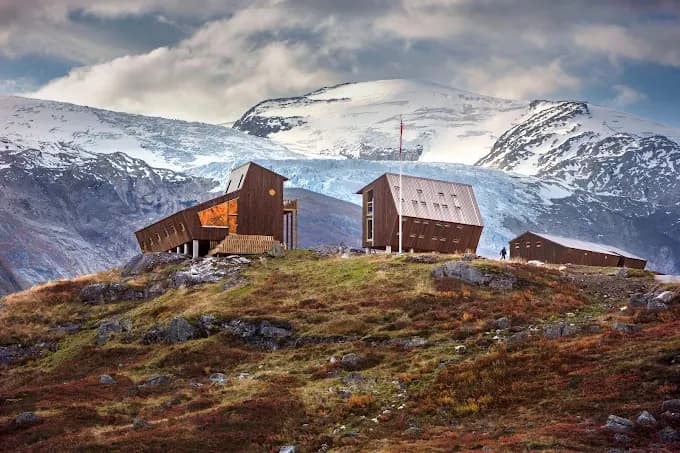
Tungestølen is a mountain refuge located in the municipality of Luster, facing the Jostedalen glacier in western Norvège. Rebuilt in 2015 by the Snøhetta design studio following the destruction of historic buildings by Storm Dagmar, it comprises nine pentagonal wooden cabins designed to withstand the fierce winds of the valley. The site is accessible only on foot, at the end of a hiking trail from the hamlet of Veitastrond.
Why visit Tungestølen
Tungestølen appeals to three types of travelers. Contemporary architecture enthusiasts come to observe an award-winning project by Snøhetta, the same studio behind Oslo Opera House. Hikers find a strategic base camp at the foot of Jostedalen glacier, Europe's largest mainland glacier. Finally, travelers seeking solitude appreciate a site without direct road access, located several hours from major Norwegian cities.
The appeal of the place lies in the rare combination of a century-old tourism heritage and resolutely contemporary architecture, in a high mountain setting accessible only by your own means.
History: a century of existence and architectural rebirth
The original refuge was inaugurated in 1910 by the Norwegian Tourism Association (Den Norske Turistforening), a pioneer of hiking tourism in Norvège. For over a century, Tungestølen was managed by the Nesset family, who welcomed generations of hikers crossing the Sogn og Fjordane region.
In December 2011, Storm Dagmar swept through the valley and destroyed all the historic buildings. Reconstruction was driven by the local association Luster Turlag, which mobilized the community to rebuild a refuge adapted to the site's extreme conditions. The project was entrusted to the Snøhetta studio and completed in 2015.
The architecture chosen breaks with the traditional mountain lodge: nine pentagonal and oblique volumes, shaped to deflect the dominant winds. Materials favor laminated veneer lumber, CLT (cross-laminated timber) and local pine cladding, following both structural and environmental logic.
What to see and do
The architectural ensemble
The nine pentagonal cabins are the main visual attraction. Their angular openings face the glacier and valley, offering carefully composed views of the landscape. The main building houses the restaurant, common areas and a panoramic terrace.
The natural setting
The refuge overlooks Jostedalen glacier, whose ice tongues descend into several nearby valleys. Surrounding trails allow for day excursions to viewpoints, alpine lakes and parts of Jostedalsbreen National Park.
Accommodation and dining
The site has approximately 30 beds, divided between a large dormitory and more intimate cabins. The restaurant offers a buffet breakfast and hot meals in the evening, in the tradition of DNT mountain refuges. Accommodation remains simple, in the spirit of a refuge rather than conventional hospitality.
Practical information
- Final access: on foot only from Veitastrond.
- Season: open during the summer season, typically from late June to mid-September depending on conditions.
- Capacity: approximately 30 beds, reservation essential during peak season.
- Equipment to bring: hiking boots, waterproof and windproof clothing, water and snacks for the hike.
- Rates: moderate nightly rates, with a discount for DNT members.
The site is exposed to mountain weather: it's wise to check forecasts before heading up, particularly outside peak summer.
When to visit
The window for visiting is narrow. The refuge operates only during the summer season, when the approach trail is clear and temperatures are manageable at altitude. July and August offer the best hiking conditions, with long daylight hours characteristic of Norwegian latitudes. June and early September are quieter but may feature lingering snow at higher elevations or rainy spells. Outside season, the refuge is closed.
How to get there
Tungestølen sits above the hamlet of Veitastrond, in the Sogn og Fjordane region (Vestland), north of Sognefjord.
- By air: the nearest airport is Sogndal Haukåsen, approximately 74 km by road from Veitastrond.
- By car: from Sogndal, expect a winding mountain road to Veitastrond, the trail starting point.
- On foot: from Veitastrond, a marked trail of approximately 3.8 km, alternating stairs and flat sections, leads to the refuge. Allow 1.5 to 2 hours depending on pace and load.
The absence of road access to the refuge is part of the experience and shapes the logistics of your stay: everything carried up goes on foot.
What to see in the region
Tungestølen sits within a Norwegian region rich in major sites, several accessible within the same travel loop:
- The Sognefjord, Norvège's longest fjord, of which Veitastrond forms one of the inner arms.
- The Geirangerfjord, UNESCO-listed, further north.
- The historic district of Bryggen in Bergen, a logical urban stop before or after the mountains.
- The Bergen fish market, in immediate proximity to the harbor.
Frequently asked questions
Frequently asked questions
Planning a trip to Norvège
Tungestølen fits naturally into an itinerary combining fjords, mountains and coastal cities. To build a coherent journey around this destination, consult our suggestions on Norvège.
Interested in this visit?
We can include it in your personalised itinerary.