Norwegian Glacier Museum
Norwegian Glacier Museum
In Fjærland, the Norwegian Glacier Museum combines Sverre Fehn architecture, climate exhibition, and gateway access to the Jostedalsbreen national park.
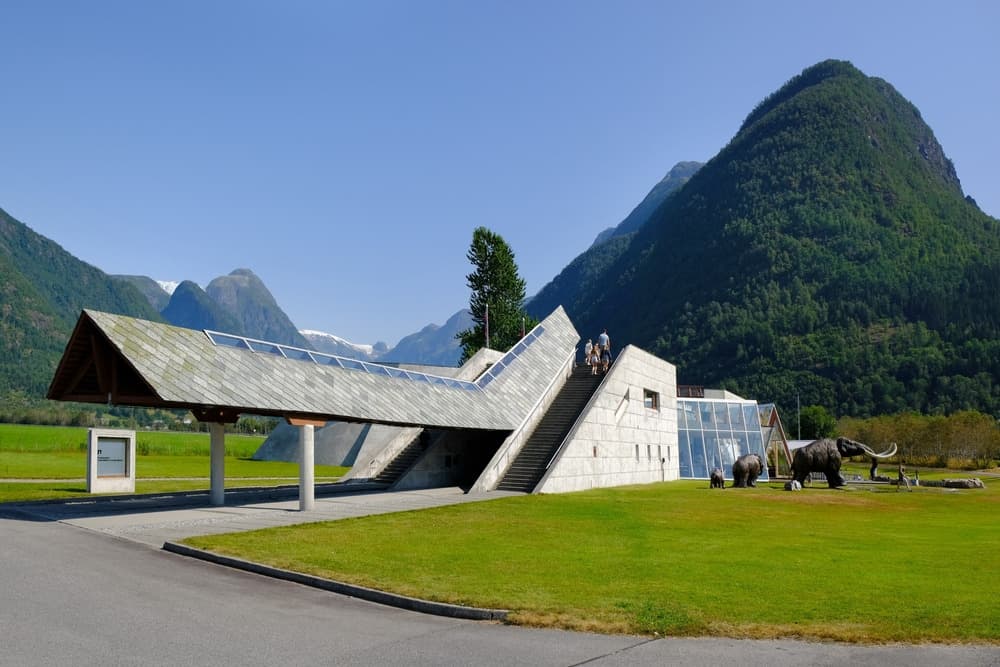
Located in Fjærland, on the banks of Fjærlandsfjord and at the foot of Jostedalsbreen national park, the Norwegian Glacier Museum (Norsk Bremuseum) is a reference centre for glaciers, climate, and the geological history of Norvège. The building, designed by architect Sverre Fehn, also serves as a visitor centre for continental Europe's largest glacier, located a few kilometres to the north.
Why visit the Norwegian Glacier Museum
- Architecture by Sverre Fehn, Pritzker Prize 1997, distinguished by the Betongtavlen award in 1992.
- A permanent exhibition translated into 13 languages, updated in 2016, combining science, climate, and prehistory.
- A strategic location for exploring accessible glacier tongues of Jostedalsbreen (Bøyabreen, Supphellebreen).
- A family-friendly format, with an educational playground and giant mammoth sculptures outside.
Museum History
The museum opened its doors in 1991, with a mission to collect and share knowledge about glaciers and climate. Norwegian architect Sverre Fehn designed a raw concrete building that dialogues with the surrounding peaks and glacier tongues. The work earned him the Betongtavlen prize as early as 1992 and left a lasting mark on Norwegian museum architecture.
In 2007, the institution was enriched with the Ulltveit-Moe Climate Centre, which broadened its scope to contemporary climate issues. The museum also became the official visitor centre for Jostedalsbreen national park, a function that now structures much of its programming.
What to see
The permanent exhibition
Updated in 2016, the permanent exhibition is translated into 13 languages. It alternates interactive installations, touchscreens, ice manipulations, and real-time weather simulations. The tour explains glacier formation, their dynamics, and their role in carving Norwegian fjords.
Several striking pieces punctuate the visit:
- A sculpture by Bård Breivik created with ice collected from Jostedalsbreen.
- The film Falkeblikk dedicated to the glacier, screened every hour.
- A giant screen broadcasting calving footage filmed for the museum's 25th anniversary.
- A section dedicated to glacier calving, fed by observations conducted in 2017.
The Ulltveit-Moe Climate Centre
The exhibition "Our Climate is Fragile" forms the heart of the climate centre. It unfolds in two parts. The first part traces natural climate changes, from Earth's formation through ice ages. The second presents future projections for 2040 and 2100, and illustrates the expected consequences of warming.
Ötzi and Glacier Archaeology
A room is dedicated to Ötzi, the prehistoric man found in the Alps, set alongside objects discovered in Norvège's glaciers. This dialogue illuminates living conditions in ancient periods and the role of ice as an archaeological conservator.
Outdoors
The educational playground surrounding the building features giant mammoth sculptures. This space extends the visit outside and allows children to familiarize themselves with Ice Age imagery.
Practical Information
- Visit duration: allow 1.5 to 2.5 hours to explore all exhibitions.
- Admission: moderate ticket prices with reductions for children, students, families, and groups. An annual membership option is available. Check current rates before your visit.
- Services: shop, café area, parking with electric vehicle charging station managed by Mer.
- Accessibility: exhibition translated into 13 languages, family-friendly itinerary.
When to Visit
The museum is open daily from April to October, with extended hours in July and August. From November to March, access is by request. The high summer season (June to September) coincides with the ferry and shuttle service to the glaciers: this is the most convenient time to combine museum visits with field excursions. Spring and early autumn offer quieter crowds.
How to Get There
- By car: approximately half an hour from Sogndal or Skei. Allow half a day from Bergen and nearly a full day from Oslo via Lærdal.
- By coach: regular connections from Sogndal, Skei, and Bergen.
- By ferry: a passenger ferry connects Balestrand to Fjærland from June to September, a scenic fjord crossing.
- Glacier bus: two daily runs in summer season (June to September) connect Fjærland to Supphellebreen and Bøyabreen glaciers, with a stop at the museum.
Nearby Attractions
The museum is an ideal starting point for exploring the southern Jostedalsbreen national park. The Bøyabreen and Supphellebreen glacier tongues are accessible within a few kilometres. Fjærland is also known as Norvège's "book village," with second-hand bookshops housed in former barns.
More broadly, the Western Fjords region lends itself to a complete itinerary. The Nærøyfjord, a UNESCO World Heritage site, and the Geirangerfjord rank among the country's most striking landscapes. In terms of towns, the Bergen fish market allows you to extend discovery toward the coast.
FAQ
Frequently asked questions
The museum is located in Fjærland, on the banks of Fjærlandsfjord, in southwestern Norvège. It serves as a visitor centre for Jostedalsbreen national park.
The museum is open from April to October. The period from June to September is most convenient as it coincides with the ferry from Balestrand and the glacier bus to Bøyabreen and Supphellebreen.
Allow 1.5 to 2.5 hours to explore the permanent exhibition, the Ulltveit-Moe Climate Centre, and the outdoor playground.
Yes. The exhibition features interactive devices, ice manipulations, and an outdoor educational playground with giant mammoth sculptures.
Yes. In summer season, the glacier bus serves Bøyabreen and Supphellebreen, two Jostedalsbreen tongues accessible within a few kilometres of Fjærland.
Plan Your Trip
The Norwegian Glacier Museum integrates naturally into a tour of the Western Fjords. To build a complete itinerary including Bergen, Sogndal, and Jostedalsbreen, consult our suggestions for travel in Norvège.
Interested in this visit?
We can include it in your personalised itinerary.