Borgund Stave Church
Borgund Stave Church
Built around 1180 at Borgund, this stave church is one of Norvège's best-preserved stavkirker, featuring intricately carved portals and a seven-tiered roof.
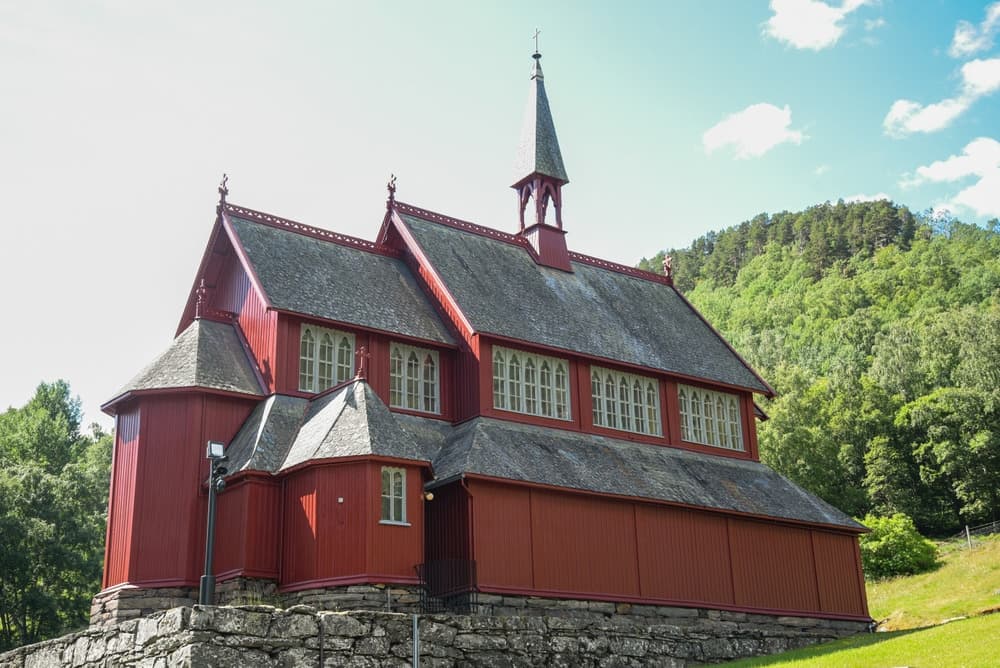
Built around 1180 in the hamlet of Borgund, in Sogn og Fjordane, the stave church (stavkirke) ranks among Norvège's most complete examples. Its seven-tiered pitched roof, portals carved with dragons, and exterior wooden shingle galleries bear witness to an architectural tradition born at the crossroads of Viking paganism and medieval Christianity.
Why Visit Borgund Church
Of the 28 stavkirker remaining in Norvège today (compared to over a thousand in the Middle Ages), Borgund is the one that has changed least since its construction. The original structure is nearly intact: no baroque additions, no windows cut through later, no major transformations. You see what a 12th-century traveler saw, modulo a few restorations.
The site combines three rare elements within the same perimeter: the medieval church itself, a visitor center with an exhibition on stave church art, and the old royal road (Kongevegen) that runs right beside it. The entire site can be explored in half a day and fits well as a stop on the route between Bergen and Oslo.
History of the Church and Norwegian Stave Churches
Stave churches appear in Norvège during the 11th century, shortly after the country's Christianization. Their name derives from stavar, those vertical wooden support posts (as opposed to logs laid horizontally as in log construction) that bear the entire structure. The technique allows for tall construction without metal nails, using mortise and tenon joints.
Borgund was erected around 1180, within the Lærdal parish. The iconography of its three carved portals openly blends animal motifs, interlace patterns, and dragons inherited from Viking imagination—a rare detail, as most Christian churches of the period erased such pagan references. Over the centuries, the building underwent several restorations, notably after the Protestant Reformation in the 16th century, which changed religious practices without leading to its demolition. The church ceased being parochial in the 19th century when a new temple was built nearby, which paradoxically saved it: it became a historical monument before modern alterations could harm it. Today, Borgund is primarily a museum. The royal road Kongevegen running alongside it has been honored with a European heritage prize for the quality of its restoration.
What to See On Site
Exterior Architecture
The seven-tiered pitched roof gives the building its characteristic elongated pyramid silhouette. Take a few minutes to walk completely around the building to observe:
- The three carved portals, with the west portal featuring dragons and animal interlace work of Viking inspiration
- The wooden shingle cladding covering roof and walls, treated with pine tar for preservation
- The central roof turret and small round turret above the chancel
- The exterior galleries circling the church, which protected load-bearing walls from the elements and sheltered the faithful before services
Interior
The interior is dark and low-ceilinged, with massive pine posts structuring the nave. A few medieval runic inscriptions are visible on the walls, carved by former visitors.
Visitor Center
An attached modern building houses a permanent exhibition on stave church construction, their evolution, and restoration techniques. Worth exploring before visiting the church itself.
Practical Information
The church is open only during daytime hours, with entrance through a moderate admission ticket (senior, child, and family discounts available). Tickets are purchased on-site at the visitor center.
Allow 1 to 1.5 hours at the site including the exhibition. English-language guided tours are offered in season. Photography is permitted outside; inside, check on arrival.
When to Visit
The site is open year-round, with extended hours between April and October and reduced hours in winter. Note two annual closures: May 17 (Norwegian National Day) and September 30.
Peak tourist season runs July–August. To enjoy the site without crowds, prioritize May, June, or September, preferably early in the day. Winter offers a special atmosphere, with the church standing out against a snow-covered landscape, though road access requires caution.
How to Get There
Borgund sits in the Lærdal valley, somewhat off the beaten path but accessible:
- By car from Flåm: approximately 1 hour via the E16, passing through the Lærdal tunnel (24.5 km, the world's longest road tunnel)
- From Oslo: 4.5 to 5 hours via the E16 through Hønefoss and the Hallingdal valley
- From Bergen: approximately 4 hours combining E16 and a ferry at Gudvangen, or via the Voss route
- On a guided excursion: several operators depart from Flåm with stops at Lærdalsøyri (old wooden village) and the Stegastein viewpoint
What to See Nearby
- Vindhella Road: ancient paved mountain route, accessible on foot immediately nearby, a characteristic example of 19th-century Norwegian civil engineering
- Maristuen Fjellstuemuseum: former mountain way station converted into a small museum on high-altitude life
- Blaaflat Farm Museum: traditional farm presenting the agricultural history of Lærdal
- Lærdalsøyri: village on the Sognefjord with a protected 19th-century wooden quarter, 30 minutes by car
- Stegastein viewpoint: panoramic platform overlooking the Aurlandsfjord, on the road between Lærdal and Aurland
Frequently Asked Questions
Frequently asked questions
No, or only marginally so. Today the building functions essentially as a museum. A few special ceremonies may occasionally be organized, but it is no longer a parish church.
1 to 1.5 hours suffices to walk around the church, explore the visitor center exhibition, and observe the carved details on the portals. Allow more if you combine this with a walk on Vindhella Road.
Yes, the site remains open year-round with reduced winter hours. The E16 and Lærdal tunnel are cleared of snow, but plan accordingly with a properly equipped vehicle and check road conditions before departing.
Rules vary by season and guided tour. Exterior photography is unrestricted. For the interior, check with the visitor center upon arrival.
No, Urnes (12th century, UNESCO-listed) is older. However, Borgund is among the best-preserved in its original state, making it a key reference for studying stave church architecture.
Extending Your Journey
Borgund Church fits within a broader heritage itinerary spanning fjords and ancient royal roads. To plan a stay combining stave churches, fjords, and Hanseatic towns, explore our Norvège circuits, or discover other historic sites such as Bryggen in Bergen and Akershus Fortress in Oslo.
Interested in this visit?
We can include it in your personalised itinerary.