Vigeland Park
Vigeland Park
At the heart of Oslo's Frogner Park, Vigeland Park brings together over 200 sculptures by Gustav Vigeland along a 850-metre axis, with free access.
Vigeland Park brings together over 200 sculptures in bronze, granite and wrought iron along a central 850-metre axis, at the heart of Frogner Park in Oslo. Conceived and designed by sculptor Gustav Vigeland, the ensemble welcomes approximately one million visitors each year and is the world's largest sculpture park created by a single artist.
Why visit Vigeland Park
The site offers a free outdoor art walk, open at all times. The works explore the ages of life, emotions and human relationships, within a landscape that changes with the seasons. The visit combines monumental art, landscape architecture and urban wandering, just 20 minutes from the Royal Palace.
History of the park
Born in Mandal in 1869, Gustav Vigeland trained in Europe before establishing himself as one of Norway's major sculptors. In 1921, he signed an agreement with the City of Oslo: he received a studio in Frogner in exchange for bequeathing all his future works. Three years later, his fountain project evolved into a far more ambitious sculptural ensemble, entirely conceived and designed by the artist.
The construction spanned several decades. Between 1940 and 1949, over 200 sculptures were installed according to Vigeland's plans, who supervised every detail of the layout—from railings to lighting fixtures—until his death in 1943.
What to see in the park
The ensemble unfolds along a central 850-metre axis, punctuated by five major sculptural groupings.
- The Main Gate: completed between 1924 and 1933, it marks the monumental entrance with its wrought iron railings.
- The Bridge: 100 metres long and adorned with over 50 bronze sculptures created between 1925 and 1933. Here stands the Sinnataggen, the angry little boy who became the symbol of the park.
- The Fountain: imagined as early as 1906 and installed in 1947, it rests on six giants supporting a large basin from which water cascades down.
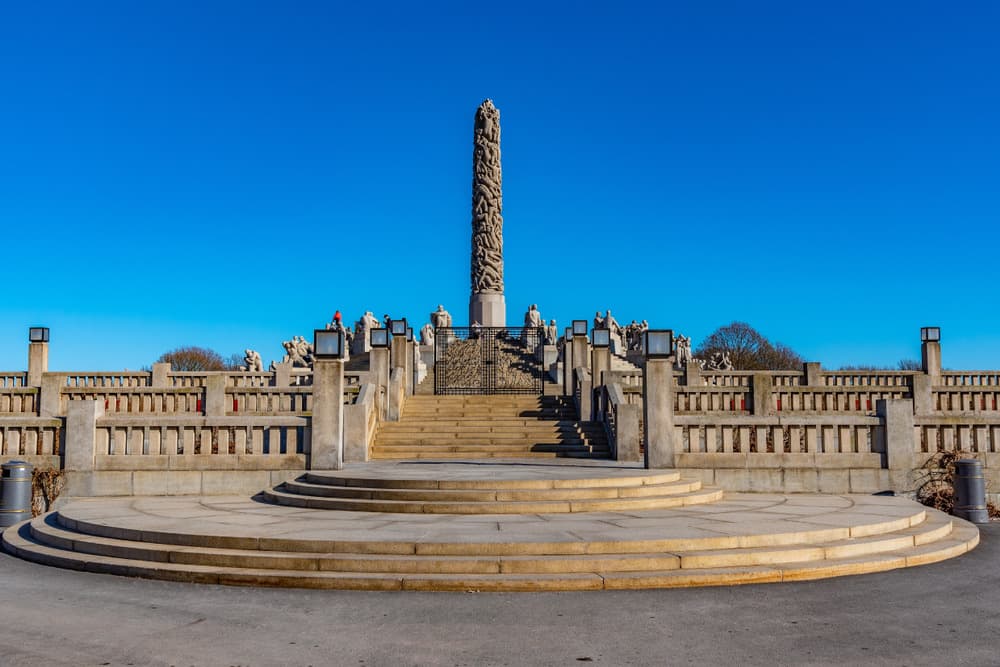
- The Monolith: a granite column over 17 metres tall carved from a single block, grouping 121 human figures. Completed in 1943 after 14 years of work, it is surrounded by 36 sculptures illustrating the human condition.
- The Wheel of Life: a circular work 3 metres in diameter, completed in 1949, which closes the central axis.
- The Vigeland Museum: housed in the artist's former studio and residence, it presents maquettes, sketches and original models, along with exhibitions of modern and contemporary art.
Practical information
Address: Nobels gate 32, 0268 Oslo, in the Frogner district. Park entry is free and unrestricted all year round (24/7). Only guided tours are paid, with fees varying depending on the option chosen.
On-site facilities include restrooms, refreshment kiosks and picnic areas. Allow 1.5 to 2.5 hours to walk the central axis and view the main works; longer if you include a museum visit.
When to visit
The park can be visited year-round, but the experience varies noticeably by season. From May to September, vegetation, the rose garden and Scandinavian light particularly enhance the sculptures, and summer evenings offer extended daylight. Autumn provides colourful contrasts appreciated by photographers. In winter, snow transforms the works and visitors are fewer; however, days are very short. To avoid crowds, choose weekday mornings.
How to get there
- Tram: line 12, Vigelandsparken stop, a few minutes from the main entrance (approximately 20 minutes from the city centre).
- Bus: lines 20 and 37, Vigelandsparken stop, just beside the park.
- Metro: lines 1 to 5, Majorstuen station, approximately 10 minutes on foot.
- On foot: 20 minutes from the Royal Palace, 25 minutes from Dansens Hus via Majorstuen.
- Car: access via Ring 2, with parking nearby.
- Bicycle: cycling paths from the city centre.
What to see nearby
The park is one stop among the capital's major sites. To extend your visit, head to the historic centre towards the Parliament Square, or consult the full Oslo guide to organise your stay. If you continue westward, Geirangerfjord and Nærøyfjord are among the unmissable landscapes of Norway's fjords.
Frequently asked questions
Frequently asked questions
No, access to the park is free and unrestricted all year round, at any time. Only guided tours and certain exhibitions at the Vigeland Museum are paid.
Allow approximately 1.5 to 2.5 hours to walk the central axis and view the main sculptures. Add an extra hour if you wish to visit the Vigeland Museum.
From May to September, vegetation and light enhance the artworks. To avoid crowds, choose weekday mornings. Winter offers a very different atmosphere, with sculptures beneath the snow.
Yes, spacious lawns, wide paths and picnic areas make it an outing suited to children and pushchairs.
Preparing your trip
Vigeland Park fits naturally into a stay in Oslo, an urban stop before the fjord landscapes or the Far North. To build a tailor-made itinerary, consult our suggestions for travelling in Norway.

Interested in this visit?
We can include it in your personalised itinerary.