Svalbard
Arctic archipelago 1,300 km from the mainland, Svalbard combines 2,400 inhabitants in Longyearbyen, 3,000 polar bears and glaciers covering 60% of the territory.
Situated 1,300 kilometres north of mainland Norway, Svalbard is an Arctic archipelago governed by an international treaty from 1920 that makes it a territory apart: visa-free entry for all, special taxation, and a Russian presence still visible in Barentsburg, a former Soviet mining town of 400 inhabitants two hours by boat from Longyearbyen. Our team considers it an autonomous destination, not merely an extension of northern Norway. Reaching it requires a flight from Oslo or Tromsø, two to three hours above the Barents Sea.
Longyearbyen, the administrative capital and only entry point, is home to 2,400 inhabitants nestled at the head of Adventfjorden, beneath the slopes of Platåberget. The town bears traces of its mining past: wooden pit heads along roadsides, an old conveyor cable, the Svalbard Museum housed in former university buildings. Since the closure of the last Norwegian mine, Mine 7, the economy has rested on scientific research (UNIS centre, the Ny-Ålesund station), the Global Seed Vault buried in permafrost away from the fjord, and polar tourism structured around local operators.
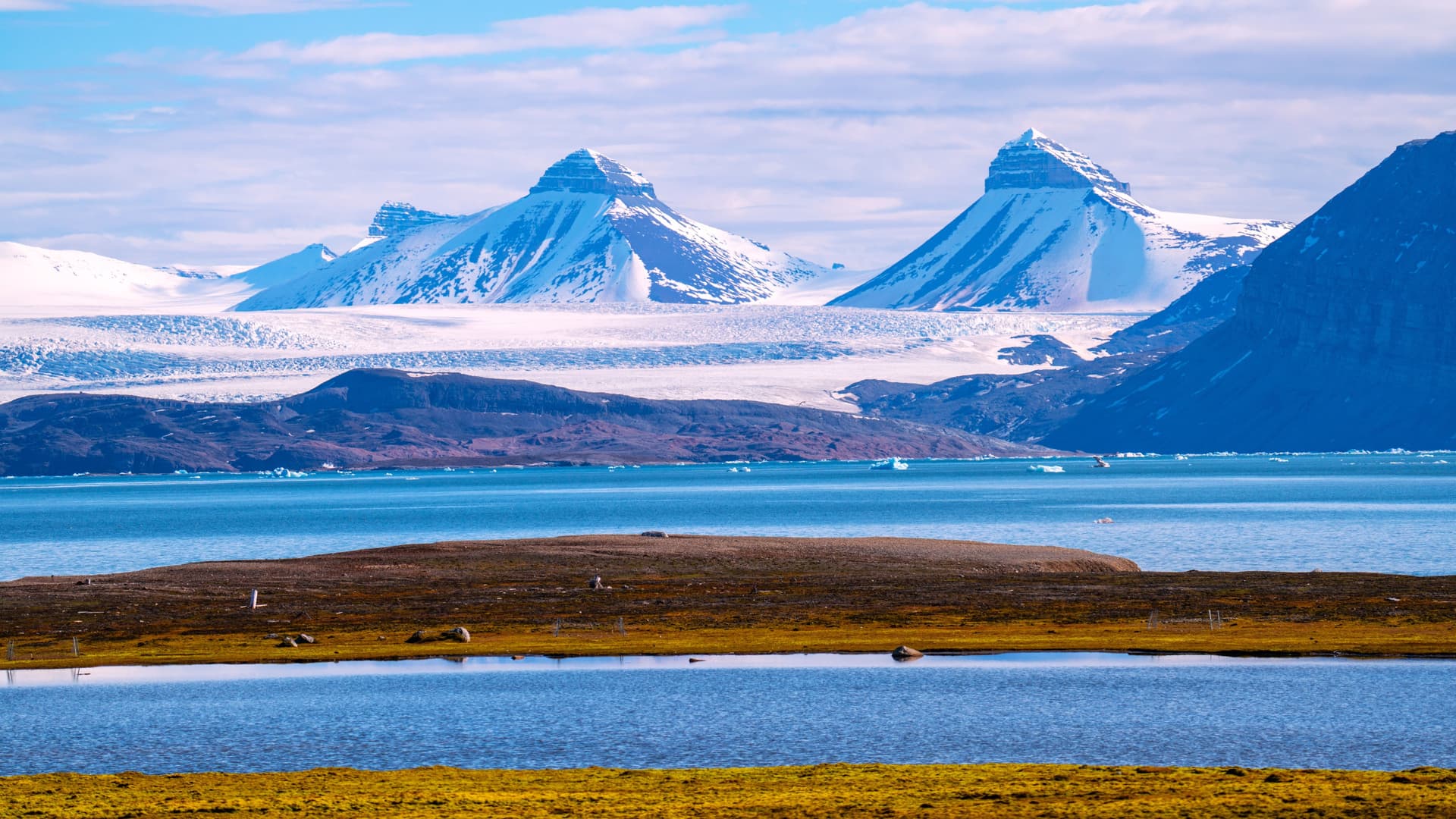
The landscape is mineral and glacial. 60% of the territory lies beneath permanent ice; the remainder is Arctic tundra dotted with saxifrages and Arctic poppies during the eight weeks of summer. Nordenskiöldbreen, a 25-kilometre glacier visible from Pyramiden, Esmarkbreen facing Longyearbyen, Monaco Glacier's front to the northwest: the ice sheets form the raw material of the landscape. On the pack ice to the north, beyond the 80th parallel, the archipelago remains one of the last territories where polar bears are still observed in significant numbers—approximately 3,000 individuals across Svalbard and the Barents Sea.
Living here requires strict rules. Venturing beyond Longyearbyen's limits means being armed against bears, guided by an approved guide, and equipped with flares. Our agency offers no excursions outside the urban zone without professional supervision. Logistics depend on operators based locally: ice-strengthened expedition vessels for summer cruises, snowmobiles and dog sleds for the winter season, all-terrain vehicles in summer for the rare drivable routes (16 kilometres total across the archipelago).
The rhythm of travel follows the light. Polar night lasts from mid-November to late January, followed by a muted blue period in February, then the sun's return at the end of this winter. Snowmobile season runs from March to May on still-passable glaciers. From June onwards, the pack ice retreats, fjords open to navigation, and the sun doesn't set until late August. At table, you'll find Svalbard reindeer fillet (an endemic subspecies, smaller and stockier), seal, Arctic char, and beer from Svalbard Bryggeri, brewed from filtered glacier water.
Svalbard appeals to travellers seeking an untamed Arctic. It's not a fjord stopover: it's another climatic country, where you accept dependence on weather, ice conditions, and collective organisation. Our team in Oslo systematically discusses this with travellers beforehand, because combining it with the mainland changes the entire itinerary.
To discover
Expedition cruise beyond the 80th north. Five to eight days aboard a small ice-strengthened vessel departing Longyearbyen, observing walruses on Moffen beaches, bears along the pack ice edge, with a stop at Ny-Ålesund, the world's northernmost research station.
Snowmobile across Nordenskiöldbreen. Crossing glaciers and frozen valleys between March and May, departing from Longyearbyen towards Pyramiden, the Soviet ghost town abandoned in 1998 and accessible only in winter via the Billefjorden pack ice.
Global Seed Vault. Visible from the outside only, 130 metres into the Platåberget mountainside. The bunker houses over one million seed samples maintained at -18 °C in permafrost, mankind's agricultural safeguard.
Dog sledding on the slopes of Bolterdalen. Half-day or full-day from the kennels in the valley, 15 minutes from Longyearbyen. In winter on snow, in summer on wheeled carts across the tundra.
Barentsburg and the Russian presence. Boat or snowmobile excursion depending on season to this enclave of 400 Ukrainian and Russian miners still active. Soviet architecture, mosaic murals, local brewery, a unique geopolitical testimony in Europe.
When to go
Two seasons sustain travel interest. From March to May, light gradually returns, temperatures oscillate between -20 °C and -10 °C, pack ice and snow remain firm: this is the snowmobile window, dog sledding, aurora watching early in the season. From June to mid-August, the thermometer rises between 3 °C and 7 °C, the sun doesn't set, ice-free fjords permit expedition cruises towards the north and west of the archipelago. September marks a brief transition, still navigable, with early snow and raking light.
We generally advise against October to early February for first-time visitors. Complete polar night (mid-November to late January) imposes permanent darkness, frequent storms, and closure of most activities outside town. Travellers specifically interested in this atmosphere or auroras in perfectly dark sky may come in November or January, knowing that the offer then limits itself to short outings around Longyearbyen.
Practical advice
Allow a minimum of four days on site, ideally five to seven to include a long excursion (multi-day cruise or snowmobile expedition). Access is by air only to Longyearbyen airport (LYR), with daily connections from Oslo and several weekly flights from Tromsø. No road links Svalbard to the mainland. On site, accommodation concentrates in Longyearbyen, from typical Coal Miners' Cabins to more comfortable establishments like Funken Lodge.
Svalbard pairs naturally with Tromsø and Finnmark, which share Arctic culture but offer more accessible continental terrain (Sámi, Alta, North Cape). A classic arrangement with us: three to four days in Tromsø, then four to six days in Svalbard. Combining with the Western Fjords or Lofoten remains possible but requires planning at least fifteen days total to avoid multiple domestic flights without clear benefit. This destination suits the curious traveller in good physical condition, ready to accept programme modifications dictated by weather and ice conditions. Children under 8 will find few adapted activities. The budget is considerably higher than the rest of the country: flight costs, mandatory guide supervision, logistics operations in polar environments.